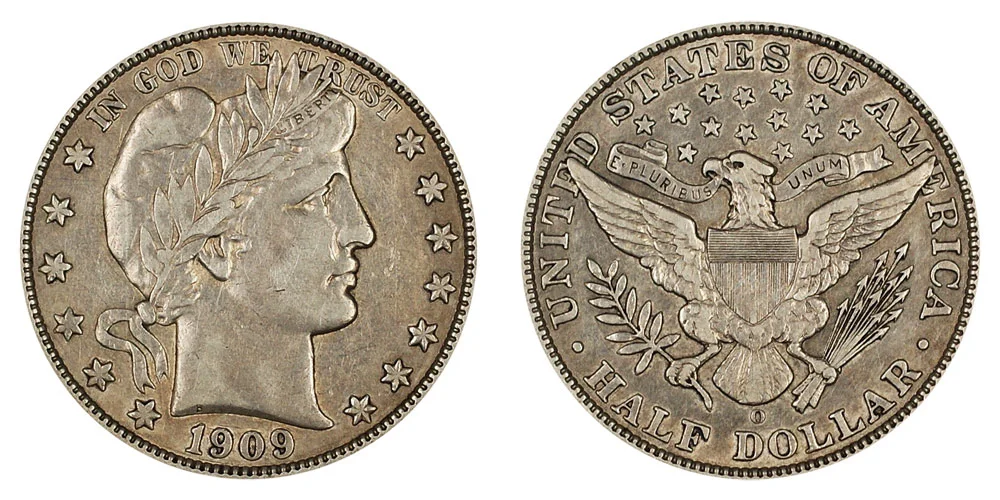
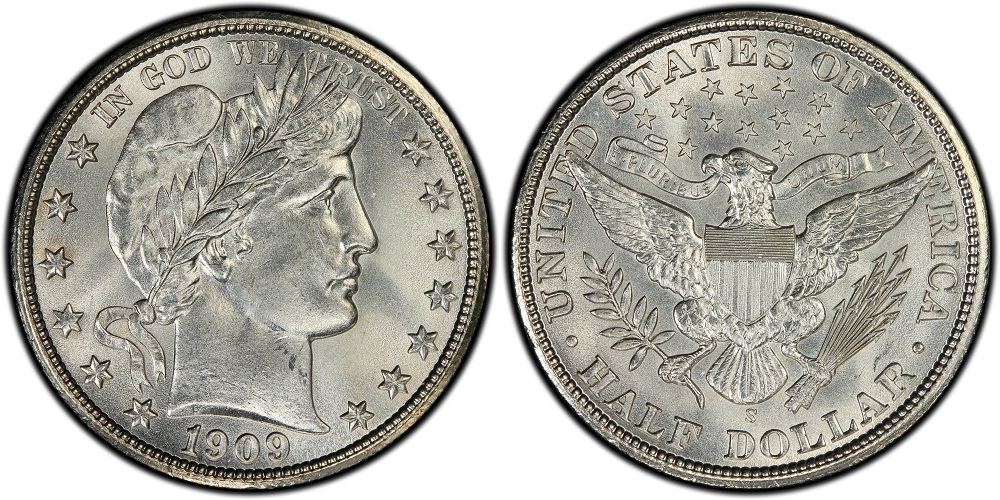
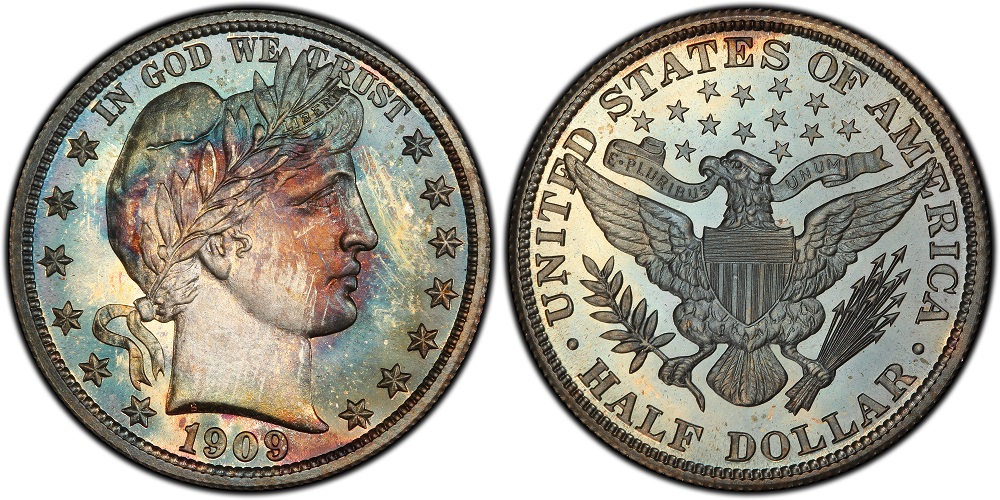
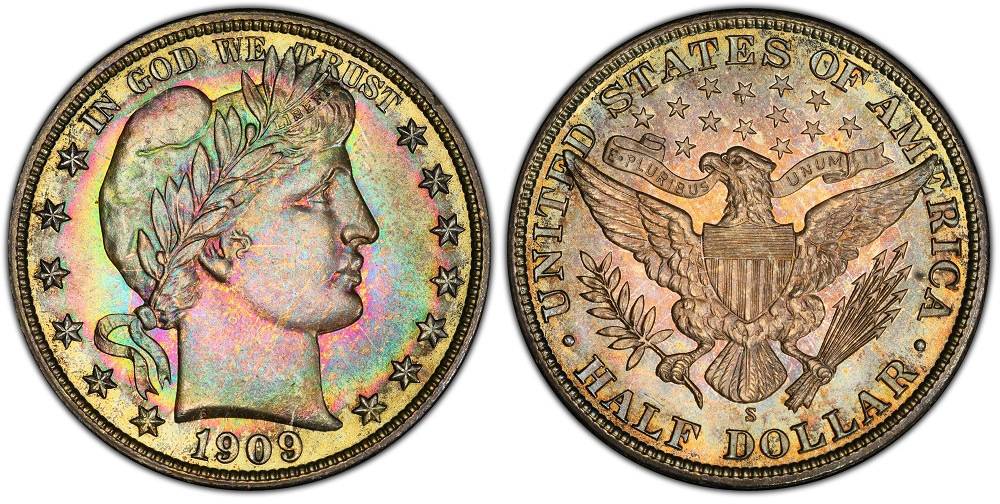
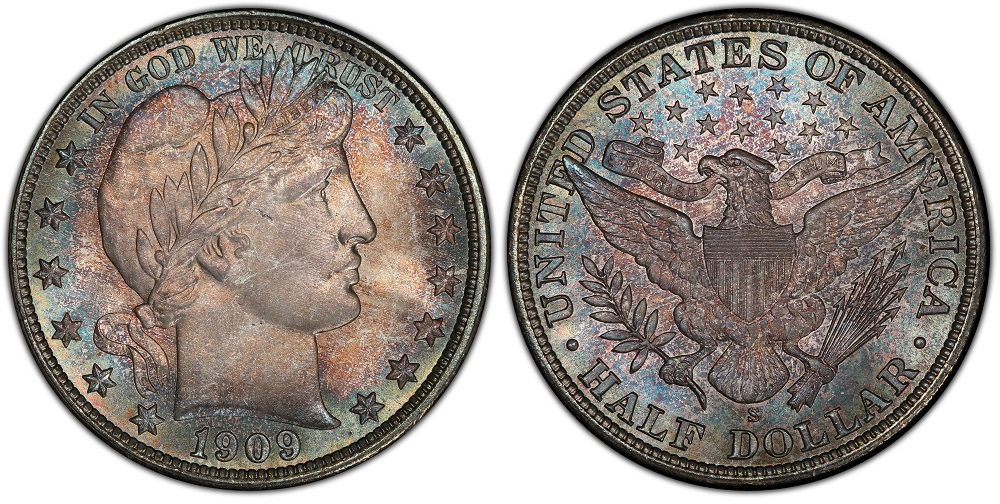
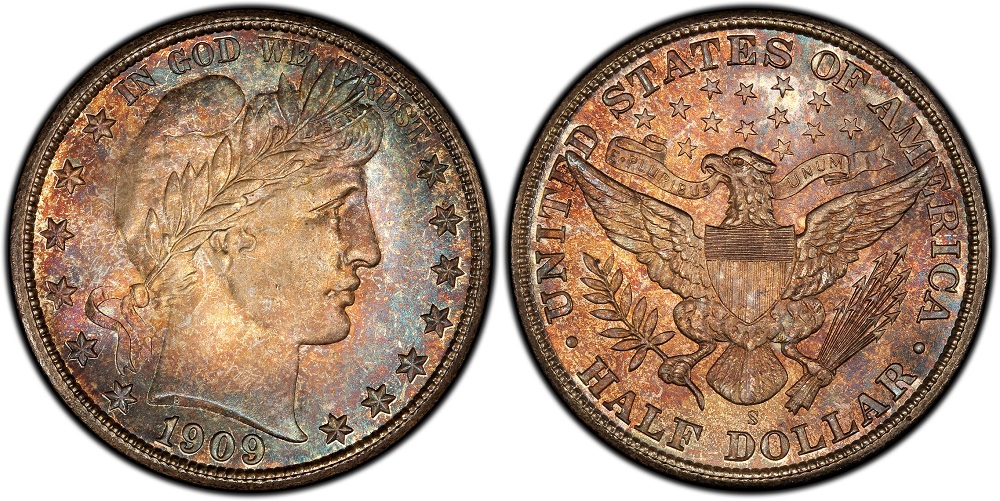
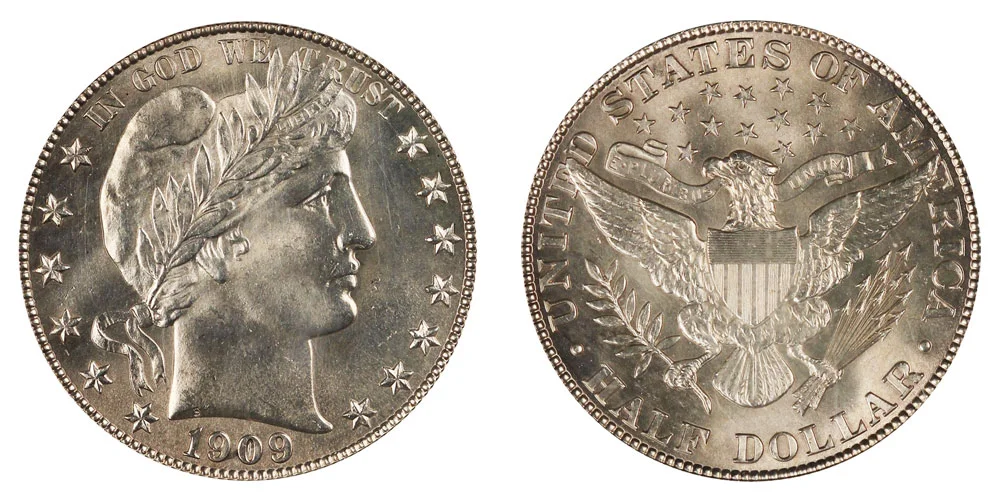
1909 Barber Half Dollar obverse and reverse showing Liberty head and spread eagle design

The 1909 Half Dollar Value Guide

One specimen sold for $44,650 at Legend Rare Coin Auctions in 2022. Even a heavily worn example is worth many times its 50¢ face value thanks to 90% silver content. The key is knowing your mint mark — because the 1909-O, the last half dollar ever struck at New Orleans, is in a different league entirely.

★★★★★ 4.8 · Rated by 1,247 collectors
Check My 1909 Half Dollar Value →
$44,650 Auction Record
(PCGS MS67, 2022)
925,400 1909-O Mintage
(Rarest Issue)
0.3617 oz Silver Per Coin
(90% Silver)
$46,000 1909-O Top Value
(Greysheet Gem MS)

Is Your Coin the Rare 1909-O?

The 1909-O was the last half dollar struck at New Orleans before the mint closed forever. Use this quick checker to see if you have one.

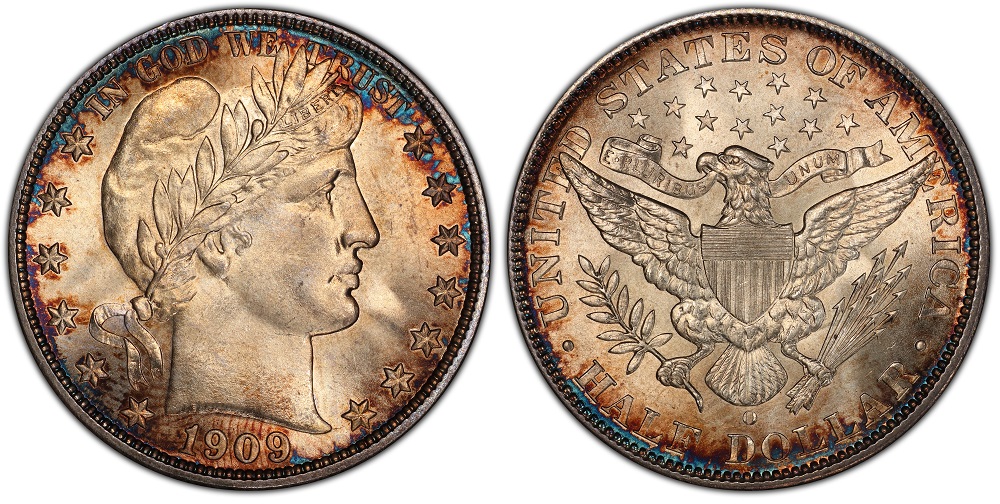
1909-O Barber Half Dollar reverse showing O mintmark vs 1909 Philadelphia reverse with no mintmark, side-by-side comparison

⚪ Common: Philadelphia (no mintmark)

No letter below the eagle's tail feathers. Mintage: 2,368,650. In worn circulated grades, value tracks close to silver melt (~$45–$60). Mint State examples are more plentiful than any other 1909 issue.

— vs —

🏆 Rare: New Orleans Mint (O mintmark)

A large, rounded "O" sits below the eagle and above HALF DOLLAR. Mintage: only 925,400 — the lowest of any 1909 half dollar, and the last half dollar New Orleans ever made. Mint State examples are genuinely scarce.

4-Point 1909-O Checklist

Describe Your 1909 Half Dollar for a Detailed Assessment

Describe what you see on your coin — mint mark, condition, any unusual features — and get a personalized written assessment.

Mention these things if you can

  • Mint mark (O, S, or none)
  • How sharp LIBERTY in headband is
  • Are eagle feathers separated?
  • Any doubling visible in mintmark?
  • Overall color — silver, gray, toned?

Also helpful

  • PCGS or NGC certification number
  • Visible scratches or cleaning marks
  • Luster — frosty or dull?
  • Weight (should be ~12.50g)
  • Where you acquired the coin

Want a specific dollar figure for your coin?

The description tool gives written guidance — the calculator below gives you an instant value range with rarity context.

Go to the Free Calculator →

Free 1909 Half Dollar Value Calculator

Three steps — mint, condition, errors — instant value estimate. No signup needed.

1
2
3
Step 1 — Select Mint Mark
Step 2 — Select Condition
Step 3 — Any Errors or Varieties?

If you're not yet sure of your coin's mint mark or condition, there's a 1909 Barber Half Dollar Coin Value Checker online tool that can estimate value from uploaded coin photos before you proceed.

Everything on This Page

Jump directly to any section:

The Valuable 1909 Barber Half Dollar Errors & Varieties

Not every 1909 half dollar is equal. Four distinct issues carry meaningful premiums above the standard date: the low-mintage New Orleans key date, the dramatic Inverted Mintmark on the San Francisco issue, the tiny but prized Philadelphia Proof, and the strong-strike San Francisco business strike in pristine condition. Study the diagnostics below to know what you have.

1909-O Barber Half Dollar reverse close-up showing the large New Orleans O mintmark below the eagle

1909-O Barber Half Dollar — New Orleans Key Date

KEY DATE $50 – $7,000+

The 1909-O is the most historically significant coin of the entire 1909 Barber half dollar family. With only 925,400 pieces struck, it has the lowest business-strike mintage among all three mints that year. More importantly, it represents the final half dollar ever produced at the storied New Orleans Mint, which closed its doors for good in 1909 after 71 years of continuous operation.

Visually identifying a 1909-O requires nothing more than locating the large, round "O" mintmark on the reverse, found directly below the eagle's tail feathers and centered above the words HALF DOLLAR. The "O" mintmark is noticeably wider than the "S" and much easier to distinguish from a blank (Philadelphia) field. On worn examples, the mintmark can be shallow but should still be legible with a 5× loupe.

Collector demand for this coin is driven by both its rarity and its historic last-strike status. Circulated examples in Fine to Very Fine command strong premiums over the Philadelphia or San Francisco issues at comparable grades. Mint State 1909-O Barber halves are genuinely difficult to locate, and even low-end uncirculated pieces (MS-60 to MS-62) can fetch several hundred to several thousand dollars depending on strike quality and surface preservation.

Eye appeal matters greatly for this date. Strike quality on New Orleans coinage was sometimes softer than Philadelphia's, so a sharply struck MS-63 or better 1909-O is especially desirable to advanced collectors building high-grade sets.

How to spot it

Turn coin to reverse. Look immediately below the eagle's tail feathers, centered above HALF DOLLAR. A large, rounded "O" (wider than an "S") is the New Orleans mintmark. On worn examples, use a 10× loupe — the letter should be legible even on AG-3 coins.

Mint mark

O (New Orleans) — final year the New Orleans Mint produced half dollars before facility closure in 1909.

Notable

Greysheet lists the 1909-O value range up to $46,000 in finest-known MS grades. Mintage of 925,400 is the lowest of any 1909 Barber half. PCGS #6517 documents this date; population reports reflect genuine Gem MS scarcity across major certification services.

1909-S Barber Half Dollar inverted mintmark close-up showing FS-501 variety with secondary S punch visible beneath the primary mintmark

1909-S Inverted Mintmark — FS-501 Variety

MOST VALUABLE ERROR $29 – $5,250

The 1909-S Inverted Mintmark (cataloged as FS-501 by CONECA) is the most sought-after die variety of the entire 1909 Barber half dollar series. The error occurred at the San Francisco Mint when a hub punch was inadvertently applied upside-down into the working die. The die was caught and corrected, but the remnants of that first, inverted "S" were not fully removed before the corrected mintmark was applied on top.

Under 10× magnification, the diagnostics are clear: look for traces of a secondary "S" shape visible beneath or around the main "S" mintmark. The original inverted punch typically appears as a ghostly impression — parts of the letter's curves are visible at the wrong orientation. At lower magnification you may simply notice that the mintmark area looks unusually "busy" or doubled compared to a normal 1909-S.

This variety carries a significant premium at all grade levels. Greysheet documents a value range from roughly $29 in heavily worn circulated condition all the way to $5,250 for Mint State examples. The variety is well known and widely collected among Barber half dollar enthusiasts and CONECA variety collectors alike.

Authentication by PCGS or NGC is strongly recommended for any suspected FS-501, as the value difference between this variety and a standard 1909-S is substantial. Ensure the coin's surfaces are original — the mintmark area on cleaned coins can produce misleading artifacts under magnification.

How to spot it

Examine the "S" mintmark under 10× magnification. Look for a secondary, upside-down "S" impression beneath or behind the primary mintmark. The extra curves of the inverted punch are most visible at the top of the letter where the original die impression was deepest.

Mint mark

S (San Francisco) only — the inverted punch error is exclusive to the San Francisco 1909 issue; the variety does not exist on Philadelphia or New Orleans coins.

Notable

Cataloged as FS-501 by CONECA and listed in major variety references. Greysheet Catalog lists this variety separately from the standard 1909-S with its own price range topping $5,250 in MS grades. Confirmed by PCGS and NGC in variety-designated holders.

1909 Proof Barber Half Dollar showing deeply mirrored fields and frosted Liberty devices with cameo contrast

1909 Proof Barber Half Dollar

RAREST ISSUE $600 – $11,000+

Only 650 proof Barber half dollars were struck at the Philadelphia Mint in 1909, making this among the scarcer proof issues of the late Barber series. These coins were produced using highly polished dies and specially prepared planchets, resulting in the deeply mirrored fields and crisp, frosted device relief that distinguish a proof from a business strike. They were sold directly to collectors and were never intended for commercial circulation.

Identifying a genuine proof requires looking for mirror-like (specular) fields — the flat areas between the devices should reflect like a polished mirror and display a clear image of your eye when held under a light source. The highest-relief devices (Liberty's portrait, the eagle) should show a noticeably frosted, almost matte texture against those mirrored fields. This cameo contrast is the telltale sign of a high-quality proof strike.

The market for 1909 proofs is driven by both series collectors and type coin enthusiasts seeking a single high-quality Barber half dollar specimen. In PR-63 condition, values run approximately $1,350–$1,370. A superb 1909 proof graded PR-68 Cameo by PCGS realized $9,900 at a Heritage Auctions sale, and an NGC PR-68 Cameo example of the same coin previously brought $11,162 at Heritage's Gene Gardner Collection sale in 2015.

Surface preservation is critical for proof Barber halves, as hairline scratches from even the lightest cleaning are magnified by the mirror fields. Only problem-free, original-surface specimens command full catalog value.

How to spot it

Hold the coin under a single point light source and tilt it. Genuine proof fields will fully reflect the light source like a mirror. Look for the cameo contrast: frosted devices (Liberty's face, eagle feathers) against brilliant, reflective flat fields. Business strikes have satiny or frosty fields throughout.

Mint mark

No mintmark — Philadelphia Mint only. All 1909 proof Barber half dollars were struck at the Philadelphia facility; no proof mintmark exists for this date.

Notable

Mintage of only 650 pieces confirmed by multiple sources including CoinMintages.com and Wikipedia mintage tables. A PR-68 Cameo example brought $11,162 at Heritage's 2015 Gene Gardner Collection sale; a second PR-68 Cameo brought $9,900 at Heritage Dallas 2015 (Coin World reported). Population of PR-68 Cameo examples is extremely small.

1909-S Barber Half Dollar in high-grade Mint State condition showing full strike detail and frosty original mint luster

1909-S Barber Half Dollar — High-Grade Mint State

BEST IN CLASS $26 – $43,000+

The standard 1909-S Barber half dollar, struck at San Francisco with a mintage of 1,764,000, is a moderately available date in circulated grades. However, in the higher Mint State grades — MS-64 and above — the 1909-S becomes significantly scarce and highly sought by date-and-mintmark collectors building high-quality Barber half sets. Greysheet lists the value range for this date as high as $43,000 in the finest certified grades.

The San Francisco Mint was known for careful production and quality-conscious striking during this era. Many 1909-S halves display the satiny to frosty luster characteristic of late Barber series output from that facility. On superior MS-65 and MS-66 examples, the strike sharpness is typically strong — eagle feathers are fully separated, LIBERTY in the headband is complete and sharp, and the fields are free of significant distracting contact marks.

Grading key points for the 1909-S: check the hair above Liberty's eye and the cheek below for the first traces of friction that push a coin from MS-65 to AU-58 territory. The eagle's breast feathers and the high point of the shield are also early-wear indicators. A coin with fully original surfaces, no cleaning, and above-average strike quality for the date can command substantial premiums over PCGS price guide minimums.

For collectors, the 1909-S in Gem or better condition represents one of the top-value standard strikes in the final years of the Barber half dollar series. Its Greysheet ceiling rivals the more famous 1909-O in top grades, making it a target for advanced set builders.

How to spot it

Look for the "S" mintmark on the reverse below the eagle's tail feathers. Assess mint state status by examining the coin under a single directional light source: frosty, uninterrupted luster over all surfaces, no flat or smooth areas at the highest points of Liberty's hair or the eagle's breast, confirms MS status.

Mint mark

S (San Francisco) — the standard "S" mintmark on the reverse, present on all 1,764,000 San Francisco business-strike examples produced this year.

Notable

Greysheet documents a value range of $26–$43,000 for the 1909-S in its catalog. PCGS price guide shows MS-65 at approximately $1,999, MS-66 around $3,225, with MS-67 and above commanding dramatically escalating premiums. Population of MS-67 and above examples is very small per PCGS census data.

Found one of these varieties on your coin?

Run the free calculator above to get a value range based on your specific mint mark, condition, and any error designation.

Calculate My Coin's Value →

1909 Half Dollar Value Chart at a Glance

The values below are compiled from PCGS, Greysheet, and recent Heritage/eBay auction data. For a full step-by-step 1909 Barber half dollar illustrated identification guide and current reference, visit coinvalueapp.com. Always verify with current price guides before buying or selling.

Variety / Mint Worn (G–VG) Circulated (F–VF) Uncirculated (AU–MS63) Gem MS (MS64+)
1909-P (Philadelphia) $45 – $60 $85 – $200 $400 – $1,090 $1,200 – $44,650
1909-O (New Orleans) ★ $50 – $75 $100 – $450 $500 – $3,000 $3,000 – $46,000+
1909-S (San Francisco) $45 – $65 $85 – $330 $400 – $800 $1,200 – $43,000+
1909-S Inverted MM (FS-501) 🔥 $50 – $90 $100 – $400 $500 – $2,000 $2,000 – $5,250
1909 Proof (PR-63+) $600 – $1,100 $1,100 – $2,000 $2,000 – $11,000+

★ Signature variety (last New Orleans half dollar ever struck) · 🔥 Rarest error variety · Values are ranges, not guarantees. Actual prices vary with strike quality, eye appeal, and current market demand.

📱 CoinKnow lets you snap a photo of your 1909 half dollar and instantly cross-reference it against current market values right from your phone — a coin identifier and value app.

1909 Barber Half Dollar Mintage & Survival Data

Historical view of the New Orleans Mint facility alongside a grouping of 1909 Barber Half Dollars showing all three mint marks
Mint Mintage Notes
Philadelphia (P) 2,368,650 No mintmark; most common 1909 issue
New Orleans (O) 925,400 Final year; last half dollar from this mint
San Francisco (S) 1,764,000 Includes FS-501 Inverted MM variety
Philadelphia Proof 650 Collector strikes only; cameo examples rare
Total (all issues) 5,058,700 Across all four 1909 half dollar issues
Composition & Specifications: The 1909 Barber Half Dollar is composed of 90% silver and 10% copper. Weight: 12.50 grams. Diameter: 30.00 mm. Edge: Reeded. Designer: Charles E. Barber (Chief Engraver, U.S. Mint). Series: Barber Half Dollars (1892–1915). Silver content: approximately 0.3617 troy ounces per coin. At current silver spot prices, the melt value is approximately $31–$34, setting a firm floor on all 1909 half dollar values regardless of numismatic premium.

How to Grade Your 1909 Barber Half Dollar

1909 Barber Half Dollar grading strip showing four specimens from worn G-4 through circulated VF-20, uncirculated AU-55, and Gem MS-64

Worn (AG–G)

Major design elements present but heavily flattened. LIBERTY in headband may show some letters; date is readable. Eagle outline visible but feather details lost. Rim may show wear into stars or letters.

Value: ~$45–$75 (P/S) · ~$50–$75 (O)

Circulated (VG–VF)

For 1909 Barbers, the new hub gives a strong LIBERTY even at Fine. Evaluate overall detail: separated eagle feathers in the reverse, hair above Liberty's eye, and the band under LIBERTY all indicate grade level.

Value: ~$85–$200 (P) · ~$100–$450 (O) · ~$85–$330 (S)

Uncirculated (AU–MS63)

No wear on high points. Check Liberty's cheek and hair above forehead for the first sign of friction. Original frosty luster must be present in all protected areas. Even light cleaning drops the grade to "details."

Value: ~$400–$1,090 (P) · ~$500–$3,000 (O)

Gem MS (MS64+)

Above-average strike with minimal contact marks. Fields and devices show full, undisturbed luster. MS-65 and above require exceptional eye appeal — no distracting marks, original color, and a sharp strike.

Value: $1,200–$44,650+ (P) · up to $46,000 (O gem)
Pro Tip — 1909 Hub Change: A revised master hub was introduced for the Barber half dollar in 1909, resulting in a noticeably stronger LIBERTY strike in the headband. Unlike pre-1901 Barber halves where a full LIBERTY indicates Fine or better, a 1909 coin can show complete LIBERTY letters even at VG-8. Graders should look at the total coin — hair detail, eagle feather separation, and overall wear level — rather than relying on LIBERTY alone. Mistaking a 1909 Fine for a Very Fine because of the strong headband strike is a known overpayment trap.

🔬 CoinKnow can help you match your coin's appearance against reference images for known grade examples before you commit to a valuation — a coin identifier and value app.

Where to Sell Your Valuable 1909 Barber Half Dollar

The right venue depends on your coin's grade and variety. Here are the four best options.

🏛️ Heritage Auctions

The largest numismatic auction house in the world. Best choice for any mint state example, certified 1909-O, or the 1909-S FS-501 variety. Heritage's deep buyer pool means competitive bidding, and their proven track record with Barber half dollars includes multiple six-figure results. Submit at least 6–8 weeks before your target sale.

🛒 eBay

Excellent for circulated examples and raw (ungraded) coins. Check recently sold 1909 Barber half dollar prices and completed listings to set a realistic Buy It Now price. Use fixed-price listings for common dates; auction format for scarcer pieces where two bidders can drive up the price.

🏪 Local Coin Shop

Fastest option for lower-grade circulated examples worth under $200. Dealers typically offer 50–70% of retail for raw coins. Bring price guide printouts to negotiate. Best for coins where grading fees would eat the premium — mostly AG through VF examples with no special variety designation.

💬 Reddit (r/Coins4Sale)

Growing marketplace for collector-to-collector sales. Works best for mid-grade circulated 1909-P and 1909-S examples in the $50–$300 range. Post clear macro photos of both sides, state the grade honestly, and price 10–15% below eBay completed sales to attract quick offers. Ship USPS Priority with tracking and insurance.

💡 Get It Graded First: For any 1909-O, any coin you believe grades MS-63 or above, or a suspected 1909-S Inverted Mintmark (FS-501), the submission fee to PCGS or NGC is almost always justified. Encapsulation provides authentication, protects from damage, and typically adds 20–40% to the realized price at auction versus a raw coin of the same grade. PCGS and NGC both offer standard and economy submission tiers for coins in the $500–$5,000 value range.

Frequently Asked Questions — 1909 Half Dollar

How much is a 1909 half dollar worth?

A heavily worn 1909 Philadelphia half dollar starts around $45–$60 for its silver content alone. Fine-grade examples trade for roughly $85–$190, while uncirculated specimens (MS-63) reach $1,000–$1,100. The rarest issue, the 1909-O, commands a significant premium at every grade due to its low mintage of only 925,400 — the final half dollar produced at the New Orleans Mint.

What is the rarest 1909 half dollar?

The 1909-O is the rarest of the three 1909 business-strike Barber half dollars, with only 925,400 produced. It was also the last half dollar ever struck at the New Orleans Mint before the facility closed that year. In mint state condition, examples are genuinely scarce and command strong premiums, with prices ranging from a few hundred dollars in circulated grades to several thousand in Gem Uncirculated.

What is the 1909-S Inverted Mintmark error?

The 1909-S Inverted Mintmark (FS-501) is a recognized die variety where the 'S' punch was initially applied upside-down and then corrected. The remnants of the first, inverted 'S' are visible beneath the final mintmark on close inspection. Greysheet prices range from about $29 for worn examples to $5,250 in mint state. This variety is cataloged by CONECA and listed in major variety guides.

How do I tell the difference between a 1909-O and a 1909-S half dollar?

Check the reverse of the coin directly below the eagle's tail feathers and above the words 'HALF DOLLAR.' A large 'O' mintmark indicates New Orleans; a smaller 'S' indicates San Francisco. The 'O' mintmark on the 1909-O is noticeably wider than the 'S' mintmark. No mintmark means Philadelphia. Use a 5× to 10× loupe for clarity on worn specimens where the mintmark may be weak.

What is the auction record for a 1909 Barber half dollar?

The auction record for a 1909 Philadelphia Barber half dollar is $44,650, achieved at Legend Rare Coin Auctions in July 2022 for an example graded MS-67 by PCGS. This represents the finest known example of this date. The 1909-O has fetched prices in the range of several thousand dollars in top Gem grades, with Greysheet listing its value range as high as $46,000 in the finest conditions.

Is a 1909 Barber half dollar made of silver?

Yes. All 1909 Barber half dollars contain 90% silver and 10% copper, with a total weight of 12.50 grams, meaning each coin holds approximately 0.3617 troy ounces of pure silver. Even the most worn specimens have a base metal (melt) value of roughly $31–$34 depending on the current silver spot price, making them worth far more than their 50-cent face value regardless of numismatic premium.

What does LIBERTY on the headband tell me about condition?

For 1909 Barber half dollars, a new obverse hub introduced that year gave LIBERTY a stronger strike in the headband. This means coins dated 1909 can show a full LIBERTY even at VG-8, unlike earlier Barber halves. Graders should look beyond just the LIBERTY letters and evaluate overall detail: hair over the forehead, cheek texture, and eagle feather separation on the reverse all factor into a correct circulated grade.

How many 1909 proof Barber half dollars were made?

Only 650 proof 1909 Barber half dollars were struck at the Philadelphia Mint, making them among the rarer proof issues of the series. Proof examples in PR-63 are valued around $1,350–$1,370, while stunning cameo proof examples graded PR-68 Cameo have sold for nearly $10,000–$11,000 at Heritage Auctions. Their deeply reflective fields and frosted devices make them prized by both type and series collectors.

Should I clean my 1909 half dollar before selling?

Never clean a 1909 Barber half dollar. Cleaning removes the natural patina and luster, leaving hairline scratches visible under any magnification. A cleaned coin receives a 'details' or 'cleaned' designation from NGC and PCGS, which sharply reduces its market value — sometimes by 50% or more compared to an original-surface example of the same grade. Collectors strongly prefer original, problem-free surfaces over bright, artificially polished specimens.

Why did the New Orleans Mint stop making half dollars after 1909?

The New Orleans Mint suspended operations entirely in 1909 due to declining production needs and rising operational costs. The facility had been producing coins since 1838. The 1909-O Barber half dollar was among the very last coins struck there before the mint closed its doors. This historical significance adds a layer of collector interest beyond mere rarity, making the 1909-O a key date for both Barber half dollar specialists and general American numismatic history enthusiasts.
Ready to find out what your 1909 half dollar is worth?

Free, instant, no signup required. Get your value estimate in under 60 seconds.

Run the Free Calculator →